🎯 Candidate targets & over-expressed genes

The driver of this tumor is the EWSR1::KLF15 fusion, which isn't directly druggable. So this page asks a different question of the RNA-seq: among the genes the tumor turns up — well above normal tissue and above most other tumors — are there any a therapy could reach? Below is a short shortlist drawn from that over-expressed set — the selection rules are stated in How this shortlist was built and under each group — then two maps that put it in context.

Research use, not medical advice. This ranks genes by RNA over-expression in two samples from one patient (hand primary + lung metastasis), versus normal tissue (GTEx) and other tumors (PCAWG). High expression is a hypothesis-generating signal, not a validated drug target or predictive biomarker — many over-expressed genes are passengers or lineage markers, and n = 2 supports no statistics. Nothing here is a treatment recommendation; clinical decisions belong with the treating oncology and molecular-tumor-board team.

How this shortlist was built

  1. 1 · Pool
    Start from every protein-coding gene over-expressed in both samples — GTEx z-score above 3 in the hand primary and the lung metastasis. That is 96 genes (pseudogenes and multi-mapping gene families excluded). Download the full 96-gene pool (TSV) — it flags which genes were promoted to the shortlist and which were not.
  2. 2 · Therapy tiers
    From that pool, the therapy tiers take genes whose protein product has a targeted agent directed at it. We screened all 96 (DGIdb, Open Targets, ClinicalTrials.gov): exactly four have an agent that has reached human trials — ROS1, TDO2, LRRC15, SLITRK6 — and all four are shown. LEMD1 is kept as the one tumor-selective cancer-testis surface antigen with a strong target rationale, though it has no agent in humans yet. Genes whose only agents don't qualify — pain-only ion channels (SCN9A, SCN10A), CNS dopamine-transporter drugs (SLC6A3), a receptor-not-ligand case (TNFSF18), preclinical-only IGF2BP1 — did not make these tiers. The full screen (every gene × every source, 2026-07) is downloadable as JSON, and its summary columns are in the pool TSV.
  3. 3 · Lineage tier
    The lineage & biomarker tier is an illustrative, not exhaustive, selection — strongly over-expressed genes chosen to characterize the tumor's phenotype. It is a curatorial judgement, not a ranked rule; other pool genes could reasonably sit here too.

Targeted-therapy leads

Pool genes whose protein product has an approved or clinical-stage targeted therapy directed at it (a targeted inhibitor or enzyme inhibitor). A lead here still needs the alteration confirmed — high RNA is a pointer, not proof of dependence.

ROS1 ROS proto-oncogene 1, receptor tyrosine kinase chr 6q22.1 Vesicles

Oncogenic receptor tyrosine kinase, strongly over-expressed — but expressed full-length, with no rearrangement

GTEx z 8.5 hand · 6.8 lung
PCAWG z 6.8 hand · 5.4 lung
Expression (TPM) 178 hand · 67.3 lung
Modality
ROS1 tyrosine-kinase inhibitors — crizotinib, entrectinib, repotrectinib, lorlatinib
Status
Checked in the BAMs — no ROS1 fusion
Why flagged
ROS1 sits near the top percentile of both GTEx normal tissue and the PCAWG tumor cohort in both samples — a concordant, tumor-specific signal for a directly druggable kinase, and no other RTK (MET, ALK, NTRK, EGFR, ERBB2, KIT) is elevated. That made a cryptic ROS1 fusion worth ruling out directly.
review Entrectinib in ROS1-fusion NSCLC

Screen · 2026-07 Open Targets — Crizotinib, Entrectinib, Repotrectinib +1 · non-small cell lung carcinoma (oncology) full ↓

✓ Checked in the BAMs We inspected the RNA-seq alignments at the ROS1 locus. ROS1 is transcribed full-length — 42/45 exons in the hand primary and 45/45 in the lung metastasis carry read support, with equal 5′ and 3′ coverage (≈15× across both halves in the primary) and no breakpoint step. Chimeric reads from STAR and Isofox scatter across every chromosome (including mitochondria) with no recurrent partner and nothing shared between the two samples — the signature of alignment artifacts, not a rearrangement. So this is transcriptional over-expression of the intact gene. ROS1 TKIs are indicated for ROS1 fusions/rearrangements, so benefit is not expected here on the basis of over-expression alone.
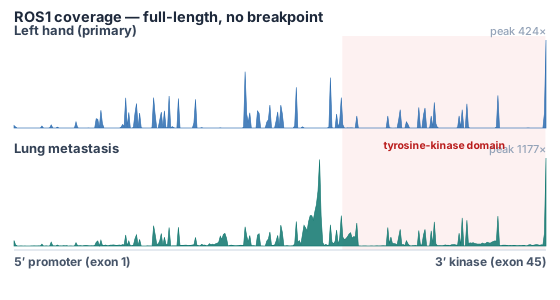
ROS1 RNA-seq coverage is continuous across all exons from the 5-prime promoter to the 3-prime kinase domain in both tumor samples, with no breakpoint step.
Per-base RNA-seq coverage across ROS1, oriented 5′→3′ (peaks are exons; the wide gaps are introns — ROS1's intron 1 alone is ~44 kb). Read support spans every exon from the promoter to the 3′ kinase domain in both samples, with no 5′ drop-off. A kinase-retaining fusion would erase the 5′ exons; instead the intact gene is transcribed full-length.
TDO2 tryptophan 2,3-dioxygenase chr 4q32.1 Plasma membrane

Immunosuppressive kynurenine-pathway enzyme, over-expressed in both samples

GTEx z 3.5 hand · 5.0 lung
PCAWG z 1.7 hand · 2.6 lung
Expression (TPM) 19.3 hand · 62.9 lung
Modality
IDO/TDO pathway small-molecule inhibitors, typically combined with checkpoint blockade
Status
Investigational
Why flagged
TDO2 converts tryptophan to immunosuppressive kynurenine; its over-expression is a candidate mechanism of local immune evasion and a conceptual combination partner for immunotherapy.
review IDO/TDO inhibitors in immuno-oncology

Screen · 2026-07 no direct agent in Open Targets · DGIdb 7 · 1 trials name the gene full ↓

Caveat An intracellular enzyme, so this is a microenvironment rationale rather than a surface target, and IDO/TDO inhibitors have not yet shown clear clinical benefit.

Cell-surface antigen candidates

Plasma-membrane pool genes that are tumor-selective surface antigens — the shape of target an antibody-drug conjugate, CAR-T, or bispecific can reach. Each card's status says whether an agent has reached human trials; all are investigational here.

LRRC15 leucine rich repeat containing 15 chr 3q29 Plasma membrane

Cell-surface leucine-rich-repeat protein, highest in the metastasis — with active sarcoma trials

GTEx z 4.4 hand · 6.5 lung
PCAWG z 1.8 hand · 2.9 lung
Expression (TPM) 36.6 hand · 159 lung
Modality
LRRC15-directed ADC and radioligand — currently ZL-6201 (ADC) and ¹⁷⁷Lu-LNTH-2403 (radioligand), both recruiting in sarcoma; earlier ADC samrotamab vedotin / ABBV-085
Status
Investigational — 2 agents recruiting
Why flagged
A surface antigen over-expressed versus normal tissue in both samples and rising in the lung metastasis; a recognized antigen on mesenchymal tumors and their stroma, now with two LRRC15-directed agents in sarcoma trials.
trial ABBV-085 phase 1 in sarcoma

Caveat LRRC15 is also expressed on tumor-associated fibroblasts, so bulk-RNA signal may be partly stromal; the earlier ABBV-085 sarcoma study did not meet its primary endpoint, though the newer agents below are recruiting.

SLITRK6 SLIT and NTRK like family member 6 chr 13q31.1 Plasma membrane

Neuronal surface adhesion protein, concordantly over-expressed

GTEx z 4.2 hand · 3.7 lung
PCAWG z 2.5 hand · 2.3 lung
Expression (TPM) 45.0 hand · 31.6 lung
Modality
SLITRK6-directed antibody-drug conjugate (sirtratumab vedotin / AGS15E)
Status
Investigational (studied in urothelial carcinoma)
Why flagged
Restricted normal expression plus concordant over-expression in both tumor samples make SLITRK6 a plausible surface-antigen handle.
trial AGS-15E phase 1 (urothelial)

Screen · 2026-07 no direct agent in Open Targets · DGIdb 1 · 0 trials name the gene full ↓

Caveat Expression here is moderate and there is no precedent in this tumor type.

LEMD1 LEM domain containing 1 chr 1q32.1 Plasma membrane

Cancer-testis surface antigen re-expressed in the tumor

GTEx z 4.2 hand · 3.6 lung
PCAWG z 1.8 hand · 1.5 lung
Expression (TPM) 40.3 hand · 26.1 lung
Modality
Cancer-testis antigen — a proposed immunotherapy target (CAR-T / vaccine class)
Status
Preclinical — no agent in humans
Why flagged
Normally testis-restricted; over-expression in both tumor samples makes it tumor-selective with low expected on-target/off-tumor risk. Kept as the one surface antigen here on target rationale alone.
study LEMD1 cancer-testis antigen study

Screen · 2026-07 no targeted agent in Open Targets, DGIdb, or trials full ↓

Caveat Unlike the two ADC targets above, LEMD1 has no LEMD1-directed CAR-T, TCR, or vaccine in human trials — the immunotherapy interest is discovery-stage only (confirmed by screening ClinicalTrials.gov). Included as a candidate antigen, not an actionable one.

Lineage & biomarker signal

An illustrative — not exhaustive — set of strongly over-expressed pool genes with no current drug, chosen to read out what the tumor is: a neuronal/neuroendocrine-like program on a myoepithelial, matrix-remodeling background. Candidate markers, not targets.

Ruled out — not expressed here

The cancer-testis antigens most commonly used as immunotherapy targets are not expressed in either sample, so they are not viable here. (Naive gene-family scans light up PRAMEF/CTAGE pseudogenes, but those are multi-mapping artifacts, not the antigen genes below.)

PRAME z -0.2·-0.2 TCR therapies, e.g. brenetafusp CTAG1B z 1.8·-0.3 TCR-T, vaccines MAGEA4 z -0.2·-0.2 TCR-T, e.g. afami-cel MAGEA3 z -0.2·-0.2 TCR-T, vaccines SSX2 z -0.2·-0.2 vaccines

Expression numbers are read from the same per-gene table as the Expression vs GTEx page — browse or download every gene there. The full fusion analysis, including EWSR1::KLF15, is on the Fusions page.

Contact Us

Please contact us with any questions or comments.